
Norway
Lofotr Viking Museum, Borg, Lofoten Islands: On the middle island Vestvågøya there is a reconstructed Viking longhouse, the largest in the world at 83 meters long. It is utterly magnificent! When I visited, there were re-enactors inside doing various handicrafts – tablet weaving, shoe-making, basket-weaving, and even one guy teaching you how to play Hnefatafl, the Vikings’ favourite board game. Of course I soaked it all up and took lots of photos – absolutely wonderful for research purposes.

Lofoten, Borg
Borgund Stave Church: This is a very late Viking building, but definitely worth a visit! It is situated in a deep valley and looks like something out of a fairy tale. There is Viking graffiti (from bored church-goers?) and allegedly babies buried underneath the floor by the altar. A peaceful, mysterious place and so atmospheric!

Borgund
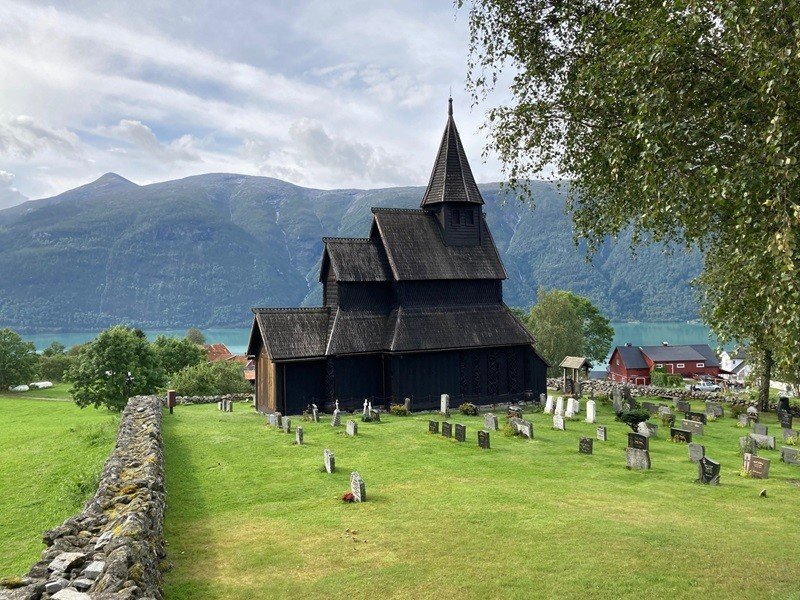
Urnes Stave Church: A UNESCO World Heritage Site, this is reached by ferry and you cross a fjord with water that looked turquoise in the sunlight. The church is situated high up on a hill and you have to drive up a very steep and narrow road. The building itself is not as impressive as the one at Borgund, but it has the most amazing panels of wood carvings on one side in what has become known as the Urnes style – sinuous intertwined animals that are just fabulous!
Urnes
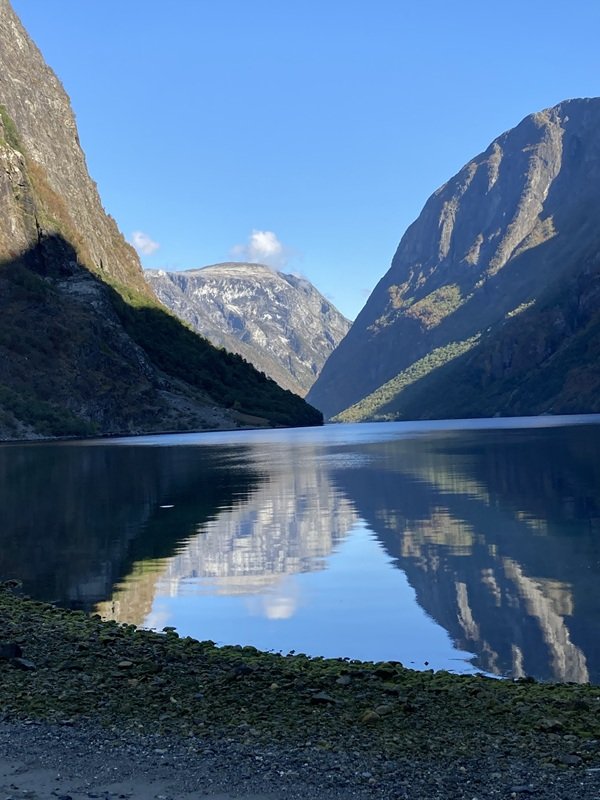
Gudvangen: Another UNESCO World Heritage Site, this is a deep valley surrounded by steep mountains mirrored in the Naerøy fjord, and it really is one of the most stunning places I’ve ever seen. There is a reconstructed Viking village – Njardarheimr – where you can see all kinds of buildings and have a go at things like axe-throwing and archery. Great fun and I even managed to hit the target!
Gudvangen
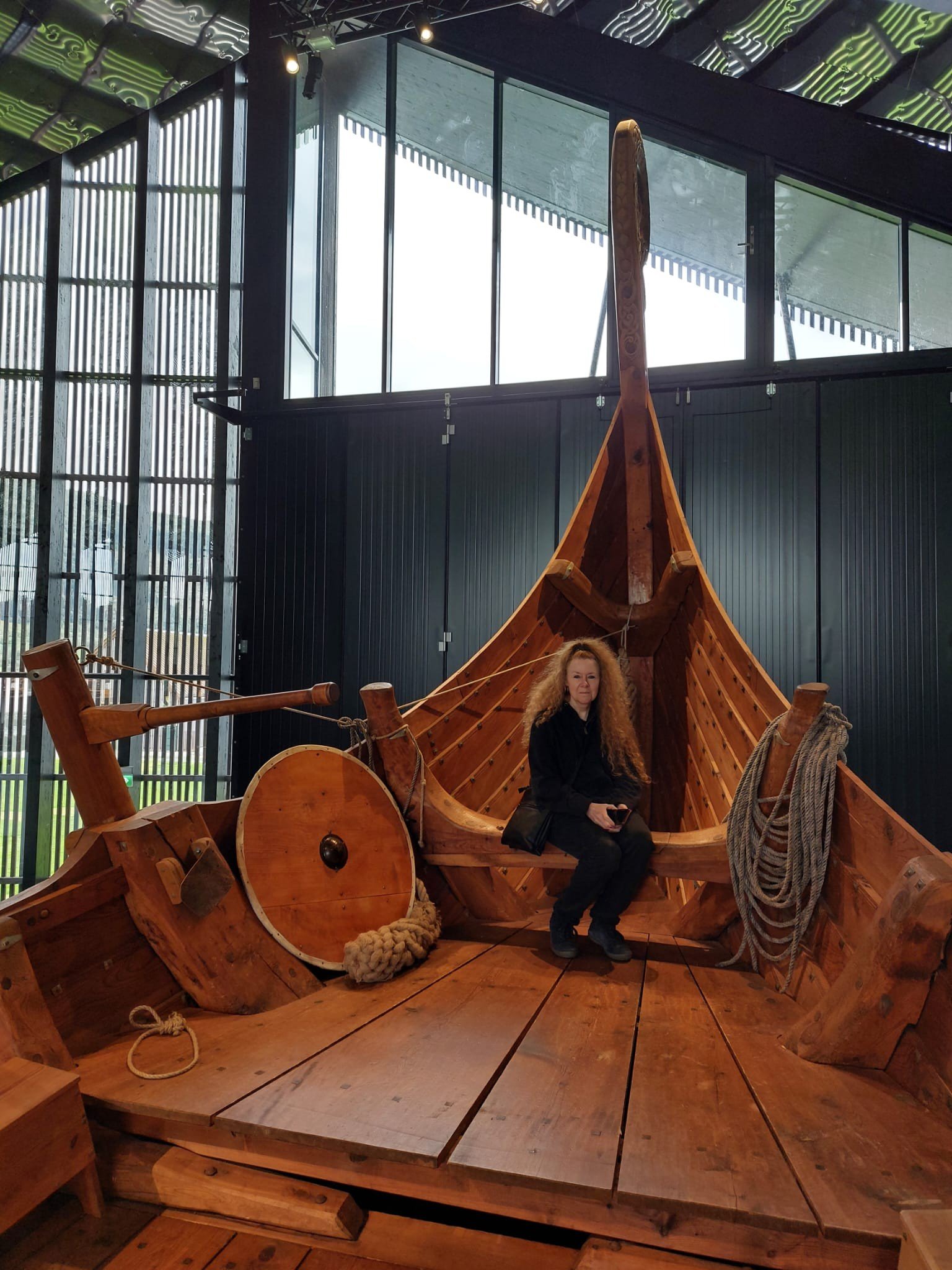
Sagastad Museum, Nordfjordeid: Here they have a replica Viking longship called the Myklebust. It is based on one found in a nearby grave mound that belonged to a powerful chieftain. The reconstructed ship is kept indoors most of the time, but is occasionally taken out and sailed/rowed along the fjord outside. It is enormous! While at the museum you are allowed to go on board and I held onto the steering oar, imagining myself out on the open sea heading for adventures. Excellent inspiration for my stories!
Sagastad, Norway
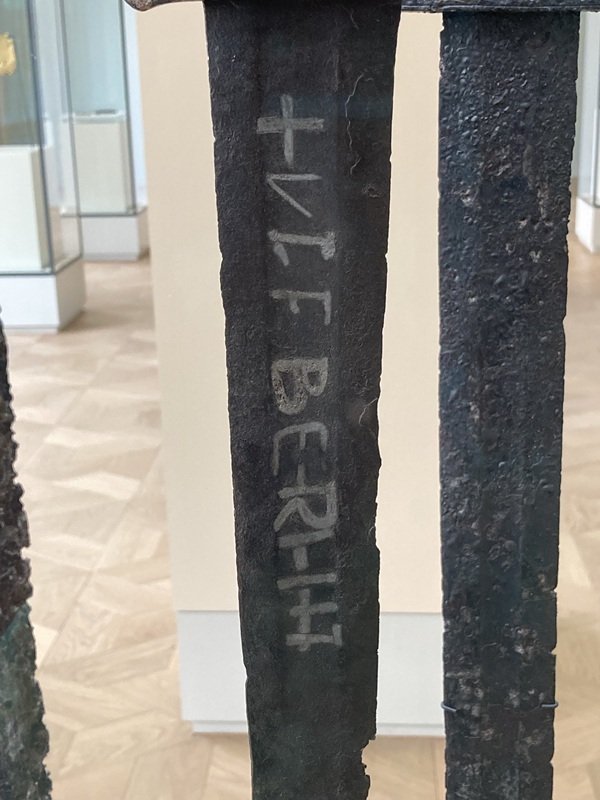
Historical Museum, Oslo: The VIKINGR exhibition here contained some of the most exquisite objects ever found from the Norwegian Viking era. There were beautiful brooches, a silver hoard, the famous Gjermundbu Helmet – the best-preserved Viking helmet in the world, together with chainmail that was found with it – a gold spur and lots of swords. For me, the highlight was one particular sword. Throughout Europe, swords marked with the inscription VLFBERHT have been found and these were supposedly the best ever made. They are thought to have come from workshops in southern Germany and presumably made by a smith called Ulfbehrt as the inscription is like a trademark. I had read about these but never seen one in real life, so this was a dream come true for me.
Oslo Historical museum
Museum of the Viking Age, Bygdøy: This contained the famous Oseberg and Gokstad ships, found in ship burials in the south-eastern part of Norway, as well as the less well-preserved ones from Tune and Borre. The museum is being rebuilt and will hopefully reopen in November 2027. I was lucky enough to see it before it closed and both the main ships were superb. The Oseberg was excavated in 1904 after it was found almost completely intact, although the pieces were crushed by the mound above it. The bits were all preserved and restored before being pieced together. The result is quite simply stunning! Built around AD 820, it was used in AD 834 as the final resting place for two very high-status ladies. No one knows who they were, but they must have been incredibly rich as the grave goods they were buried with included 3 sleighs, 5 beds, a cart, food and drink, as well as sacrificial animals – 15 horses, 6 dogs and two cows. Things like jewellery and weapons had been looted, but there were still loads of other objects. Luckily everything was well preserved because the ground around the ship was moist. The ship itself is beautifully sleek and decorated with the most amazing carvings.
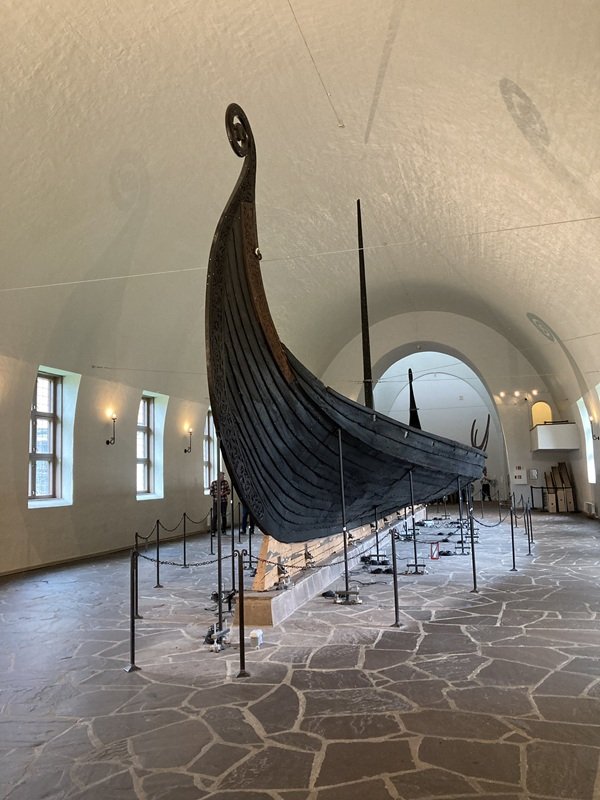
Museum of the Viking Age, Bygdøy
The Gokstad ship (built in AD 890 and used for burial around AD 900) was not embellished in the same way, but nonetheless very impressive. It was used as the basis for the reconstructed longship Íslendingur which sailed all the way to New York without any problems. The Gokstad was used to bury an important chieftain whose skeleton showed that he had been killed in combat. He too had grave goods like beds, boats, a tent, a sleigh and various animals including two peacocks – very exotic!
Borrehaugene, Borre: A sort of Viking graveyard with 50 burial mounds of various sizes built between the years AD 600-1000. Some of them are huge but all have depressions in the middle, showing that they were plundered long ago. Archaeologists have also found traces of large hall buildings and a longhouse nearby so this area was an important site.
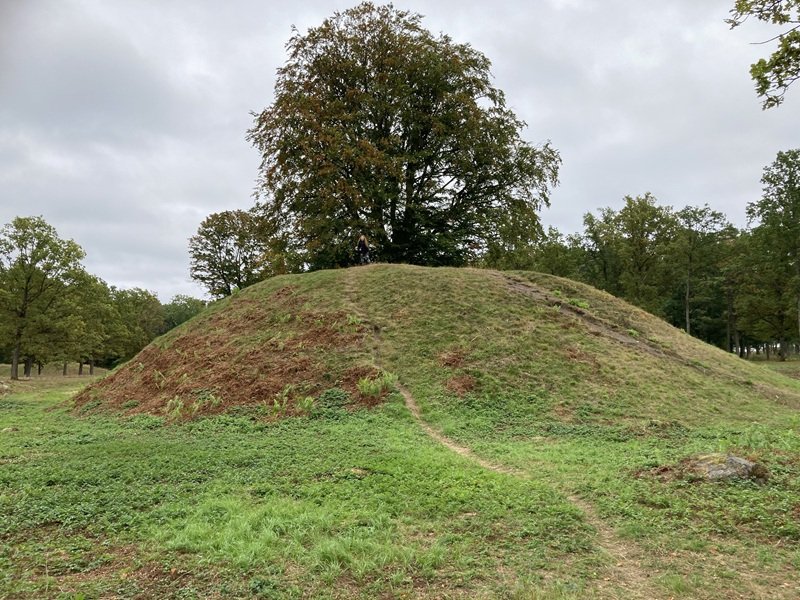
Borrehaugene, Borre
The Midgard Viking Senter next to the mounds is a small museum all about Vikings. Nearby a replica chieftain’s hall has been built – the Gildehalle. It was seriously impressive with gorgeous decorations, a lofty roof and slightly curved walls. A hall fit for a king!
Kaupang: A site that used to be a trading town in Viking times. It was on a par with Birka in Sweden and Haithabu in Denmark. There is nothing left to see nowadays, but archaeological excavations have shown the layout of it along the coastline.
The Sverd i Fjell monument, Stavanger: A sculpture featuring three enormous Viking swords made of bronze and stuck into a rocky outcropping by the sea shore. It was awe-inspiring and for me symbolized everything the Vikings achieved, and their courage and fearlessness in going out to get what they wanted. The three swords are 10 meters tall so you feel very small standing next to them. Officially, they celebrate a historic battle which took place in nearby Hafrsfjord some time in the early AD 870s when a king called Harald Fairhair supposedly united Norway. I wrote about this in PROMISES OF THE RUNES and LEGACY OF THE RUNES. A nearby sign told us it also “represents peace as the swords are planted into solid rock and may never be removed”.
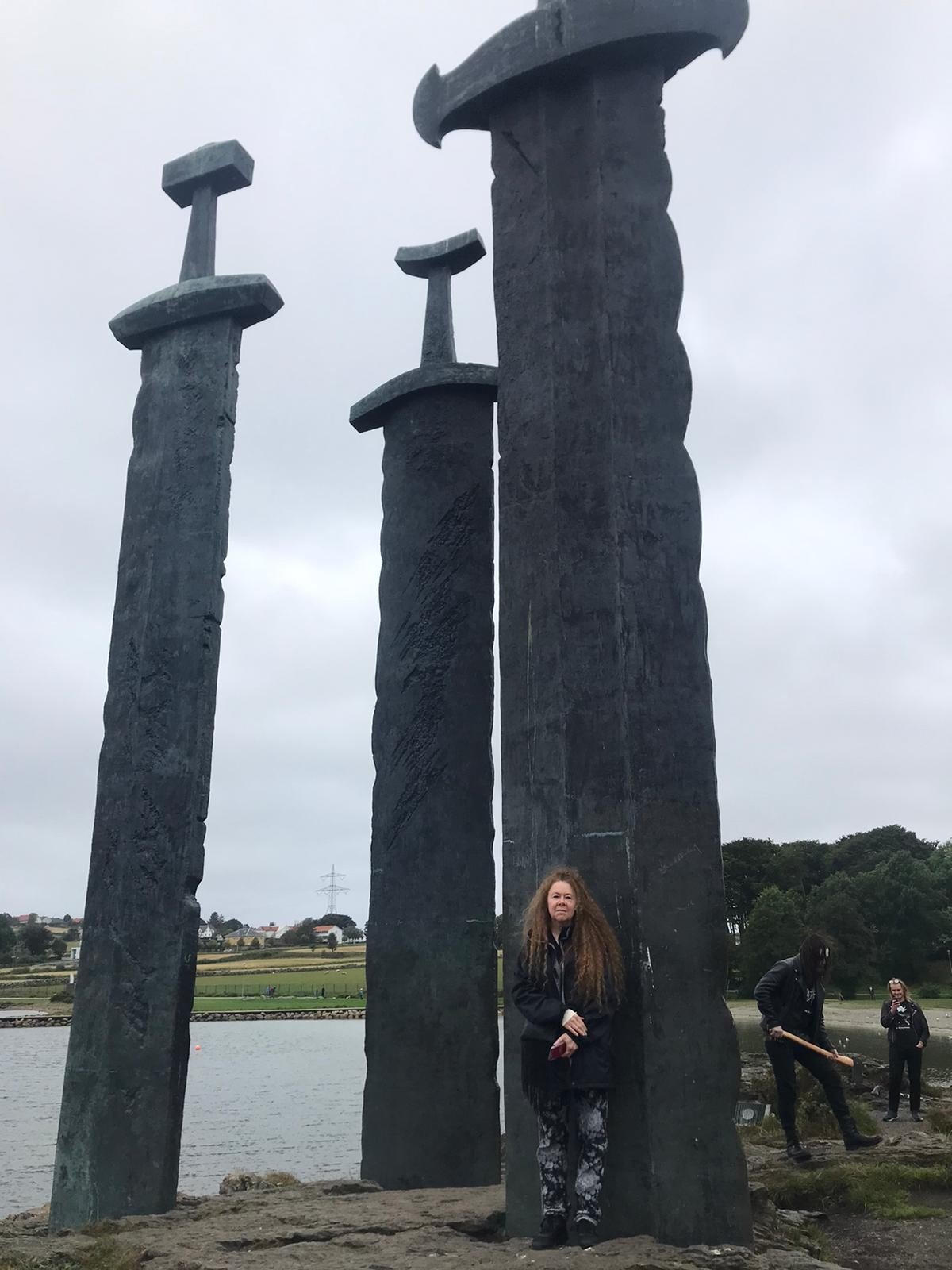
Sverd i Fjell
The Nordvegen History Centre, Avaldsnes: A site where kings used to have their halls. Located on the island of Karmøy it overlooks a narrow strait – Karmsundet. In days gone by, ships had to pass through there on their way to and from the north of the country (the so-called Norðvegr, or “the north way”), and that made it the ideal place for a king to stop them and demand a toll payment. The History Centre is cunningly situated mostly underground and can only be seen from the strait outside. The exhibition is all about the royal site and the kings who fought to own it – mainly Harald Fairhair and the king before him, Hjør. Interestingly, king Hjør was married to a princess of Mongolian descent called Ljufvina. Her tribe, the Sikhirtya, lived along the northern coast of present-day Russia, an area the Vikings called Bjarmeland. They were experts in catching marine mammals, especially the walrus which was so sought after for its tusks, and Hjør wanted exclusive access to their trade goods.

The Nordvegen History Centre, Avaldsnes