
Romans
Italy
Pompeii: After the eruption of Mount Vesuvius in AD 79, the town of Pompeii near Naples was completely buried under layers of volcanic ash. Parts of it have now been excavated and visitors can walk around to get a feel for what it was like before that tragic event. I spent a day and a half wandering around the ruins exploring and immediately fell under the spell of the place – it’s quite simply awe-inspiring! Seeing it in real life, it really hits home how sophisticated and advanced the Romans were. Also, it’s absolutely vast and if I hadn’t gone there, I don’t think I would have grasped quite how big it is. What is left of Pompeii is mostly only the streets and ground floors of buildings. Anything higher up was destroyed by the volcanic eruption, with a few exceptions. That means you have to use your imagination, but even without the second storeys, that’s not too difficult. Some taller things remain, like the small and large theatres, and the amphitheatre, and a few of the walls of ordinary buildings as well. There were some mosaic floors and wall paintings (frescoes) still intact. I was amazed at how skilled the painters were – the results were incredibly life-like and beautifully done!
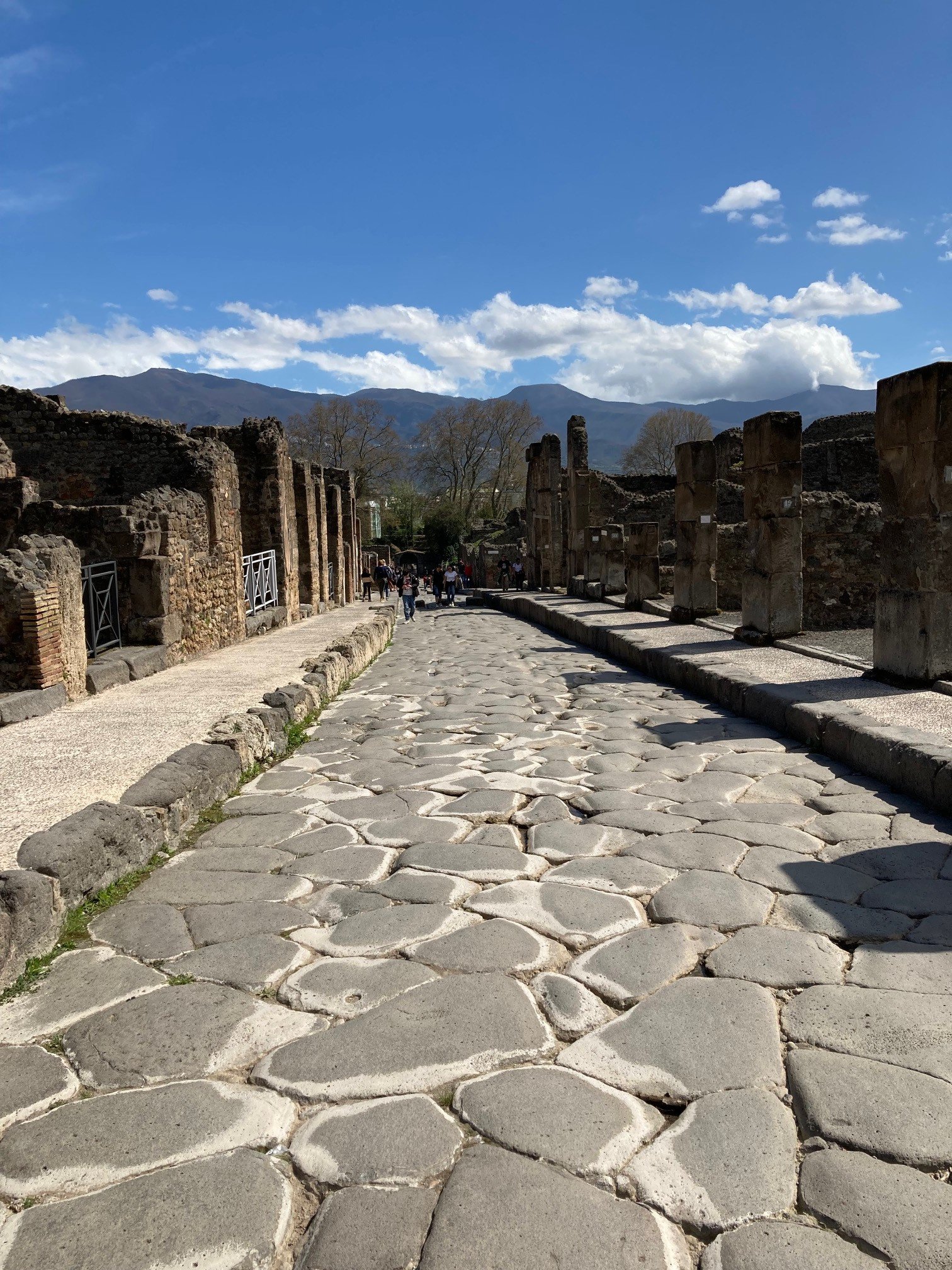
Pompeii
Since the heroes of my books SHADOWS IN THE ASHES and SHADOWS IN THE SPRING are both gladiators, a highlight for me was seeing the amphitheatre, most of which is still intact. Walking through a dark tunnel, paved with worn lava stone, and into the sunlit arena really fired my imagination. I could see in my mind the gladiators lined up for their bouts, all wearing different helmets and carrying their weapons. And I could hear the roar of the crowd – all 15,000 of them, as that was apparently how many could fit there. It must have been a real spectacle, but for the men in the spotlight it was a matter of life and death. Scary!
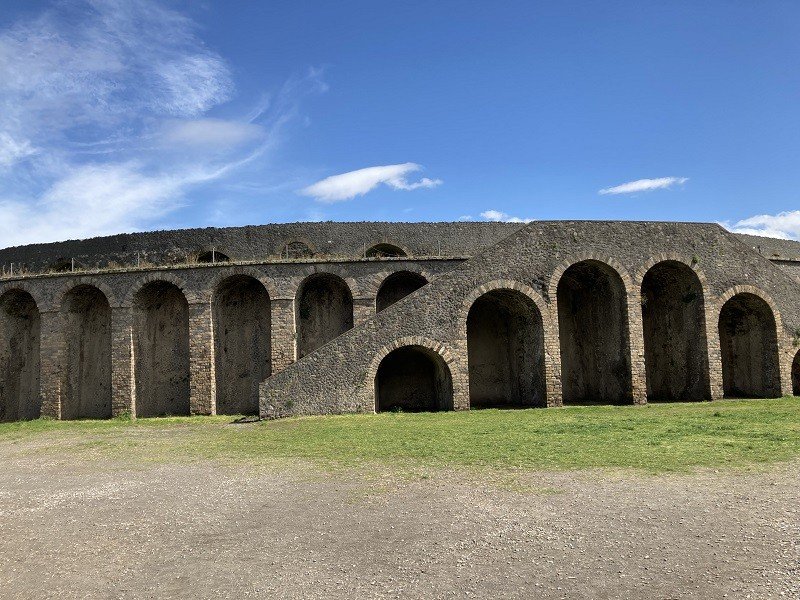
Pompeii Amphitheatre
Despite the fact that the town was destroyed so long ago, I felt as if the ancient inhabitants were still there in the shadows. They had left a part of themselves behind in the form of their art, architecture and things like political slogans and messages written on the walls. In one place, there was graffiti in the shape of a drawing of a gladiator, clearly done by a child – so charming and unexpected. And of course, there were the plaster casts of bodies found buried in the ashes. Those were poignant and moving, and made it really sink in what a massive tragedy the eruption caused.
Herculaneum: Another town that was also destroyed by the eruption of Vesuvius in AD 79 AD – most people nowadays find it more impressive. This is because it is much better preserved, with a lot of the upper storeys of the houses still intact, and the paintings on the walls in situ. Walking around its narrow streets in the Italian sunshine makes you feel as though you have travelled back in time 2000 years. The houses are beautiful and Herculaneum is much smaller – at least the part that has been excavated so far. It lies deep beneath current street level which means you can look down on it from above when approaching along a walkway that leads to the entrance. The town is a vibrant place full of colour. Even some of the ancient columns still have red paint on them, and there are houses with painted ceilings and beautifully decorated walls. The streets are narrower than those of Pompeii, giving it a more intimate feel, and I wondered how crowded it must have been back then. Probably a lot less salubrious as well, as there were no drains.

Herculaneum
There are some incredible mosaics and the craftsmen must have been very skilled indeed. In Herculaneum the public baths are much better preserved with the changing rooms more or less intact. Here it is possible to see the benches the bathers would have sat on to take their shoes and clothes off, and the little cubicles where they left their belongings. I could just imagine the hot, steamy atmosphere in there as they headed for the various baths – hot and cold – and the exercise area outside. It was wonderful to see the incredible preservation in some of the buildings. One of them even had folding doors (leading to the peristyle garden) still intact. And there were lots of roofs and upper floors, including staircases made of both stone and wood. I very much enjoyed walking around and soaking up the atmosphere.
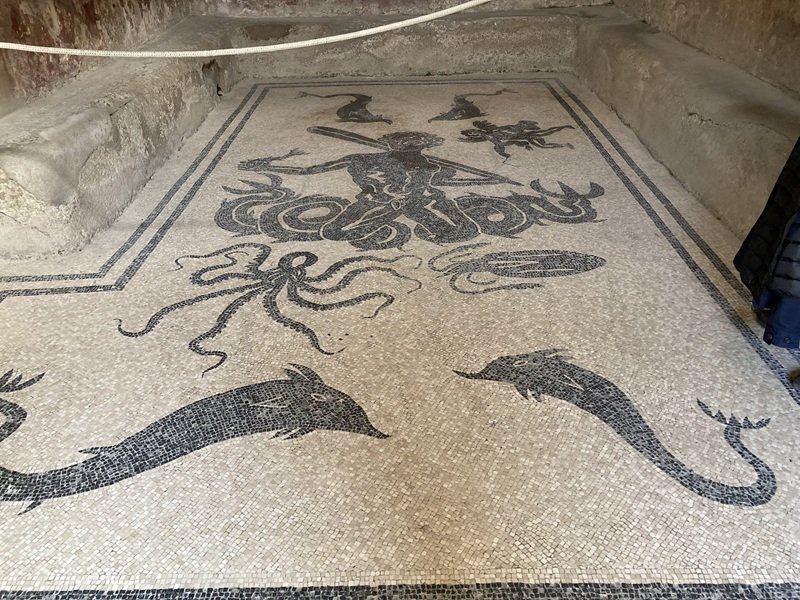
Herculaneum mosaic
National Archaeological Museum, Naples: When I visited this, there was a special exhibition about gladiators which was great for me. Gladiator is a word that evokes images of extreme violence and gory death in vast amphitheatres during Roman times. Most of them died young, with the audience baying for their blood, but I was fascinated to discover that those who survived for any length of time could become famous and feted like rock stars! (Women, in particular, seem to have been huge fans!) They feature in mosaics and on items like vases, and were clearly very popular, as was demonstrated by this exhibition.
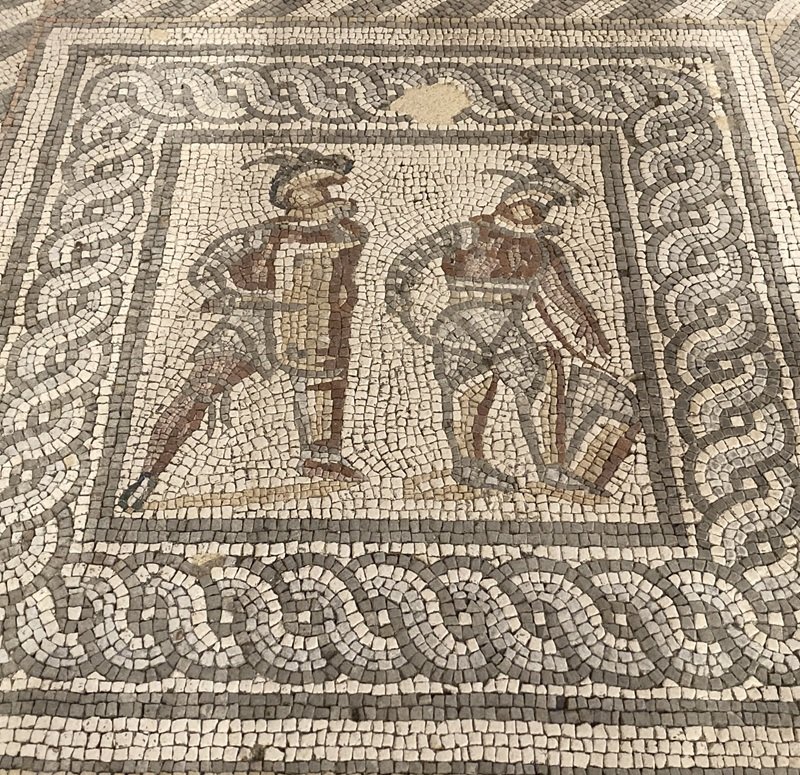
National Archaeological Museum, Naples
Gladiatorial games were put on as entertainment for the masses. Gladiators were mostly slaves or criminals, but there were occasionally free men who chose to become one in the hope of fame and fortune. They were owned by a lanista and had to sign contracts for a certain period of time, and the terms were harsh. Living together in caserma (barracks), they trained daily and were given plenty of food. There were physicians and masseurs on hand to keep them fit and healthy. However, they could be severely punished – put in shackles, whipped or branded – and had no choice about whether to fight or not. Each gladiator was given a role to play. The audience expected entertainment, and it was more fun for them if the combatants were mismatched. There were therefore different kinds of gladiator with various types of armour and weapons, some very strange indeed to make them seem barbaric. It was never an equal pairing. The spectators would have known exactly what each one was and what they could do. They fought in pairs, always matched for maximum entertainment value. I saw examples of helmets in the museum and they looked extremely heavy and uncomfortable, especially if the fights were taking place during the hot summer months. Each time they won, they were given a prize – could be coins or precious stones – and a palm leaf to signify victory. If they lost, they might be killed. The audience would add their opinion and they were obviously a blood-thirsty lot! It is difficult for us these days to imagine this as entertainment.
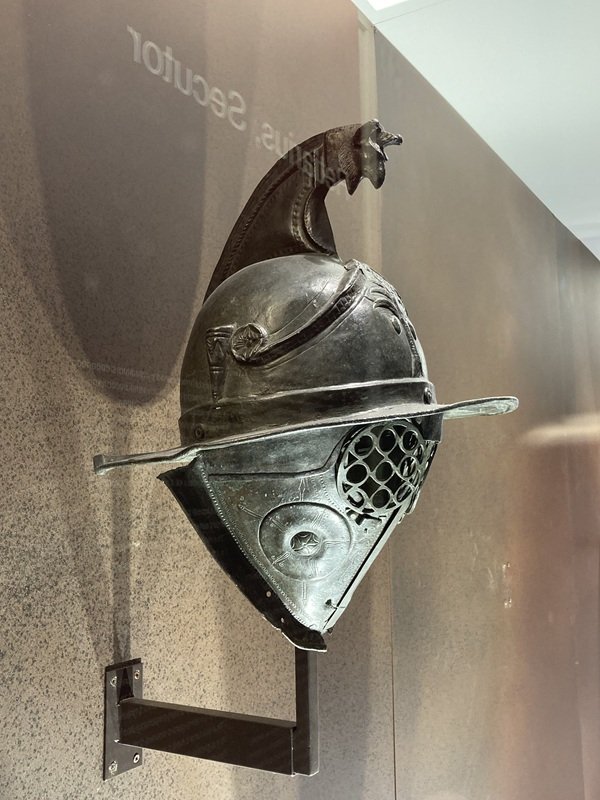
National Archaeological Museum, Naples – helmet
UK
The Roman Baths, Bath: This is one of the most amazingly preserved Roman baths in the world with its swimming pool (natatio) still intact. Built around a natural spring, it had been a place of veneration for local people long before the Romans came. Its sacred pool was where the spirit of the goddess Sulis dwelt and the hot waters were used by the Romans to supply the baths. They had completed the first bath and temple complex by 76 AD and dedicated it to Sulis Minerva (adding their own goddess to the local one). The temple had an altar and a portico of four 8 metre high columns that towered 14m above its courtyard. The pediment, which can now be seen in the present-day museum, had at its centre a great snake-haired, winged and moustachioed head, which is still impressive today.

Bath
As well as the swimming pool, there were changing rooms, a gym, frigidarium, tepidarium and caldarium (cold, warm and hot rooms), and a plunge pool. The bath complex was heated by underfloor heating. The swimming pool was in a huge room with a roof and windows. Outside, the pool of the sacred spring was open to the air but probably enclosed by a wall of tall upright slabs with openings, built against north wall of the baths. Here visitors could throw in curse tablets and offerings to the gods, asking for assistance. Today, the spring still flows through the original channels built by the Romans and it’s absolutely amazing!
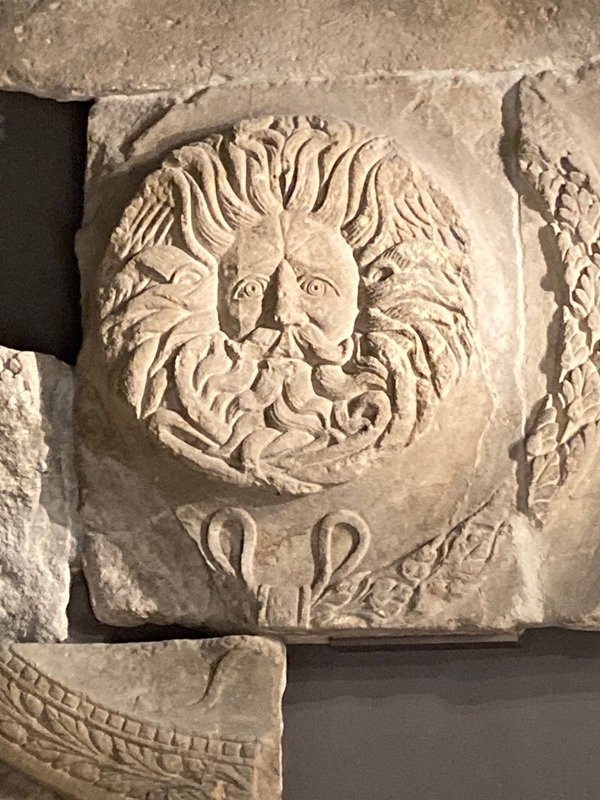
Bath
Caerleon, Wales: The main centres of Roman military control in the west after AD 51 were Usk in south Wales – home to Legio XX (the 20th Legion) – and Exeter, the base of Legio II Augusta. In the mid-AD 60s the Usk garrison was moved to a new fortress at Wroxeter and the Exeter fortress was closed and its garrison moved to Caerleon in the next decade. (AD 75-6) The Romans called it Isca after the river – now Usk – on which it stands. For over 200 years the fortress at Isca was the headquarters of the 2nd Augustan Legion. It was one of only three permanent legionary bases in Roman Britain. Archaeologists have excavated widely at Caerleon and much of the plan of the Roman fortress has been revealed. There was an amphitheatre seating up to 6,000 spectators (parts of which can still be seen), a huge area of barrack blocks for about 5,500 men, and a bath complex. A civil settlement grew up outside the defences of the fortress.
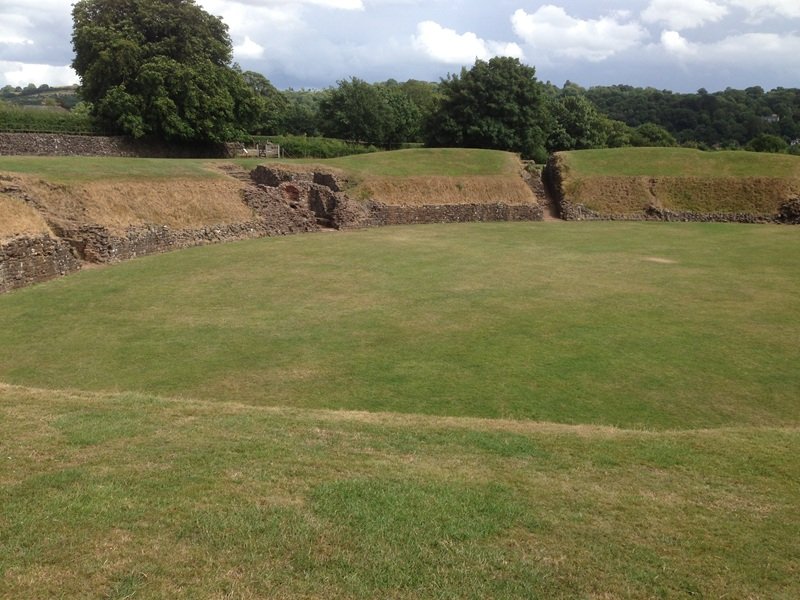
Caerleon amphitheatre
Butser Ancient Farm: An open-air museum in Hampshire that features experimental archaeology with reconstructions of buildings from various different periods of early history in Britain from the Stone Age up to and including Anglo-Saxon times. It was started with the aim of setting up a working ‘ancient farm’ so that archaeologists could test out their theories as to how people lived and farmed in the Iron Age. There are different varieties of ancient crops grown, and they have rare animal breeds. The focus is on education and research. The buildings are all based on findings from various archaeological digs, trying out different techniques to see what would work and what didn’t.

Butser ancient farm roundhouses
I was able to sit inside a huge roundhouse from the Iron Age, a whopping 50 ft (15m) in diameter and 30ft (9m) high. Very useful as the hero of SHADOWS IN THE SPRING has family living in just such a building. I had heard that these dwellings could be large, but seeing one this size for myself was quite an eye-opener. I felt very small as I sat on a log inside it, the roof soaring above me, and by my reckoning it could have seated about 40 people. I was surprised to find the central hearth on stone slabs directly on the floor, rather than raised up. The smoke rose straight up into the rafters and thatch, and because there was no smoke hole, the fire burned quietly without giving off too many sparks. Learning things like that is invaluable for research purposes, as was the way I felt slightly choked by the smoky interior at first, but then got used to it. It helped that the seats were not too close to the fire.
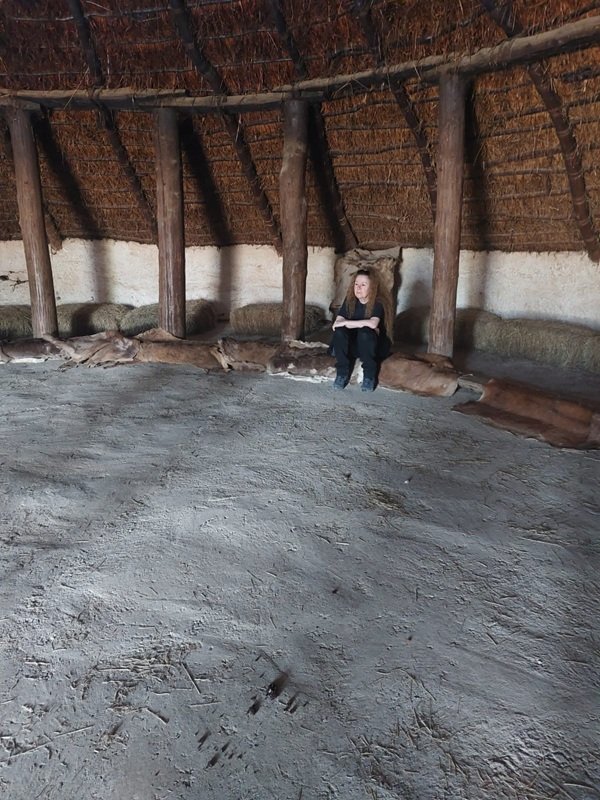
Butser – inside a roundhouse
There was also a small Roman villa with authentic-looking rooms complete with furniture and decorated walls, as well as lots of accessories. Finally, there were two Saxon hall houses, roughly from the same period but built in two different styles. They were based on similar archaeological footprints, but reconstructed using different techniques to test what could be done. To me, these looked very similar to later Viking longhouses, with raised hearths and plank flooring, and showed the link between the Saxons and the Vikings. Fascinating!
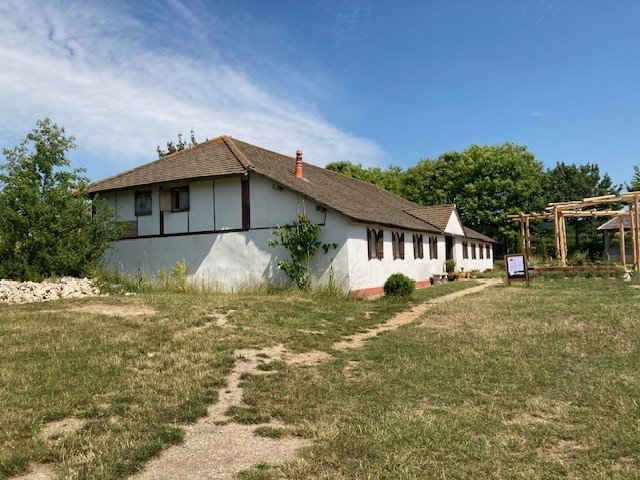
Butser Roman villa
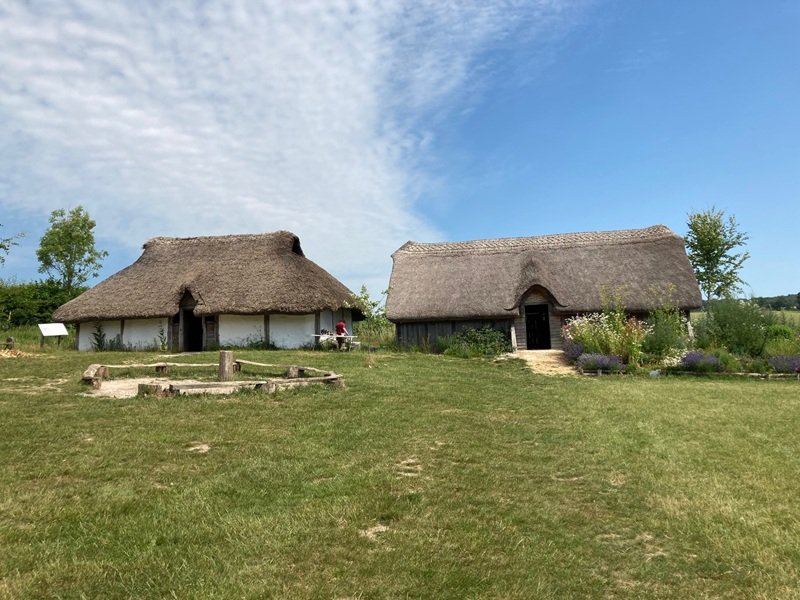
Butser anglosaxon houses
Vindolanda: This Roman fort next to Hadrian’s Wall in the north of England was very interesting to see. As well as the excavated remains of the walls, there is a museum with lots of fascinating artefacts, among them lots of Roman shoes and a collection of letters written on wooden tablets, thin slices of wood the size of postcards.

Vindolanda
Avalon Marshes Centre, near Glastonbury: An outdoor museum featuring a reconstructed Anglo-Saxon hall and a small Roman house. The hall is based on one excavated at nearby Cheddar and is beautifully decorated inside. I found it interesting to compare it to the Viking ones of the same era. They were similar but with subtle differences.

Avalon marshes centre

Avalon marshes anglosaxon hall