
The English Civil War (1641-1646)
Raglan Castle, Raglan, Monmouthshire: A once magnificent castle that is now a beautiful ruin. It inspired me to write THE VELVET CLOAK OF MOONLIGHT which I hope gives an accurate account of the castle’s final days before it was destroyed forever. This all happened at the end of the English Civil War, in 1646. At that time, Raglan was owned by the Marquis of Worcester, a staunch Royalist who supported King Charles I throughout the war by giving him lots of money and also sending troops. The Marquis was an elderly gentleman, nearly 70, but still formidable and very stubborn. As most of the Royalist forces and strongholds had surrendered to the Parliamentarians by the beginning of the summer, he must have known he was fighting a losing battle, but he still decided to make a last stand.
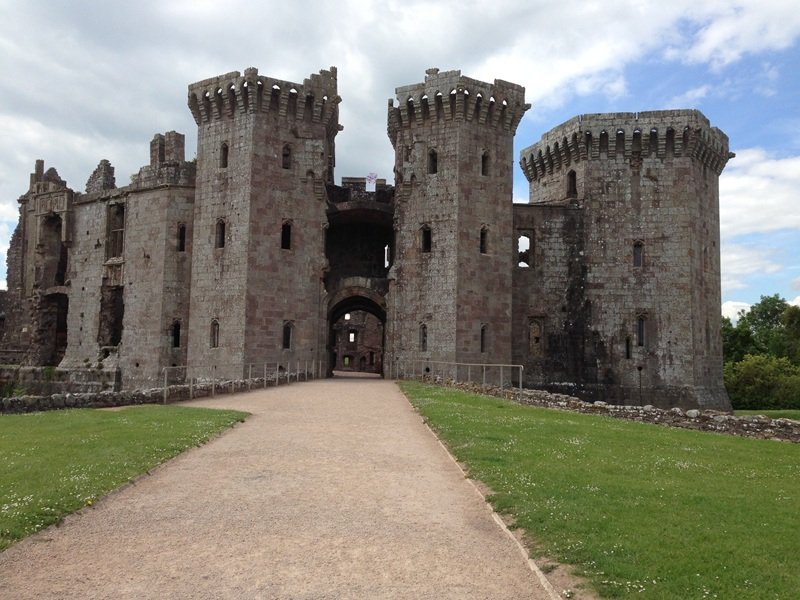
Raglan
The Parliamentarians came to lay siege to the castle, and the Marquis and his garrison of 800 men (and some women and children) held out for nearly ten weeks. In the end, however, they had no choice but to surrender, and on the 19th August 1646 they marched out through the gates for the last time. Lord Worcester was taken prisoner and escorted to London (where he died soon after of natural causes so was never tried), while everyone else was allowed to leave unharmed as long as they promised not to bear arms against Parliament again. Just to make sure no one else could use the castle against them, the Parliamentarian troops did their best to destroy the buildings but there is enough of it left for visitors to get a good idea of what it must have been like. I love it and find it very atmospheric!
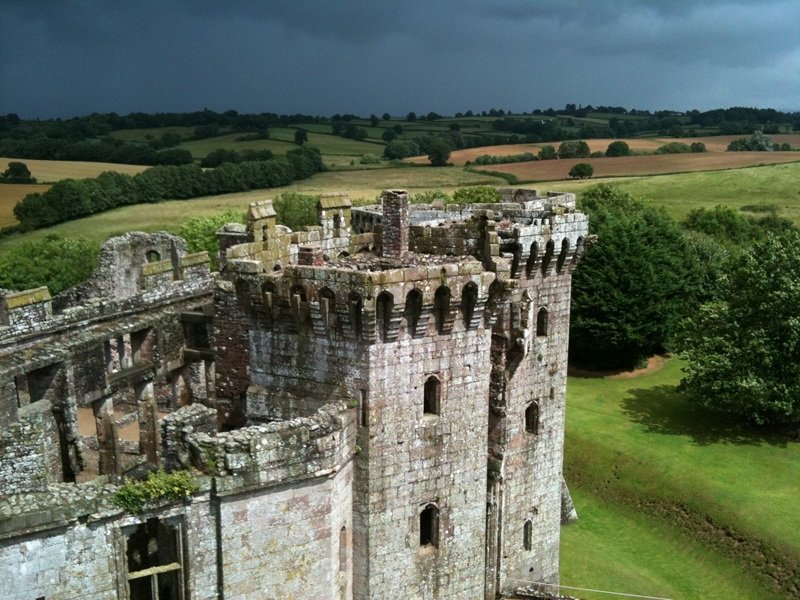
Raglan
Plymouth, Devon: This seems to have been the only West Country town to have held out for the Parliamentarian cause throughout the English Civil War, and I found it very interesting to research this period of the town’s history. Personally, I have always favoured the Royalists (well, I am a romantic novelist and what could be more romantic than the Cavaliers?), but for this story I had to argue the case for the opposition, as it were, which was fascinating. In order to study the layout of the town, I visited Plymouth several times, and in particular the so called Merchant’s House which is from the 17th century. I was able to use it as the setting for my heroine’s relatives and seeing it first-hand made it much easier to envisage her reactions upon arrival.

Plymouth merchants house
Torrington 1646 Museum, Great Torrington, Devon: This museum has a permanent exhibition about the time of the English Civil War. Visitors are given talks on subjects like clothing, weapons and medicine for this period and I had a wonderful time imagining myself back in 1646. Although I didn’t get to try on the women’s clothing (someone else did that), I wore a man’s leather jerkin which was amazingly heavy due to the fact that it was made of thick buffalo hide! I also wore a Puritan style felt hat and I was given a musket to hold. Later, I learned how to load and fire the musket (in principle only, I didn’t actually shoot or anything) and how to fight with a pike as part of the “hedge-pig” formation. Finally, I had a lesson in medicinal plants, which came in very handy when the hero and heroine of THE GILDED FAN needed medical treatment.

Torrington 1646 Museum