
Ireland
Dublin: The capital of Ireland was founded by Vikings in the 9th century. They had been raiding along the Irish coast for some time – so many tempting monasteries to pillage! – and normally they went home every autumn. But in AD 841 they set up a so-called longphort (encampment) near the mouth of the river Liffey so they could over-winter. There was a sort of black pool where the Liffey meets its tributary the Poddle – Dubh Linn = “black pool” – and the Vikings changed the name to Dyflin.
Dublin
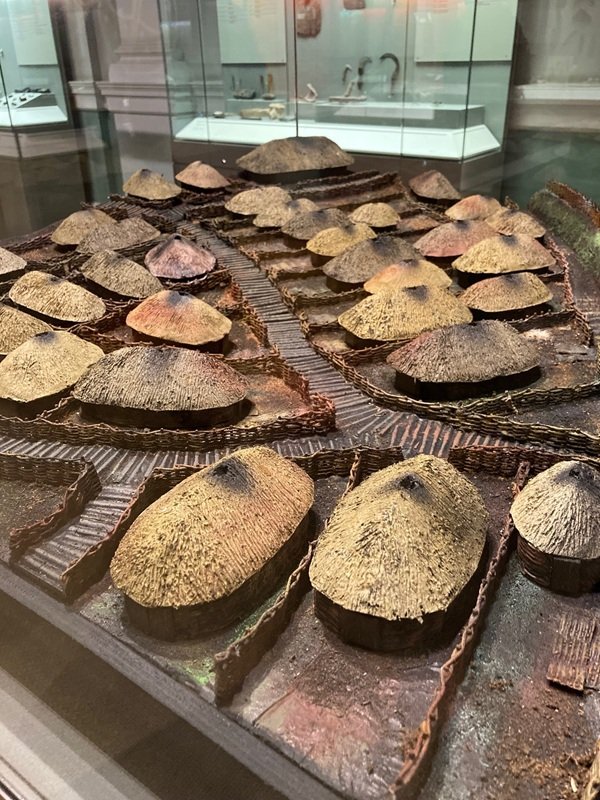
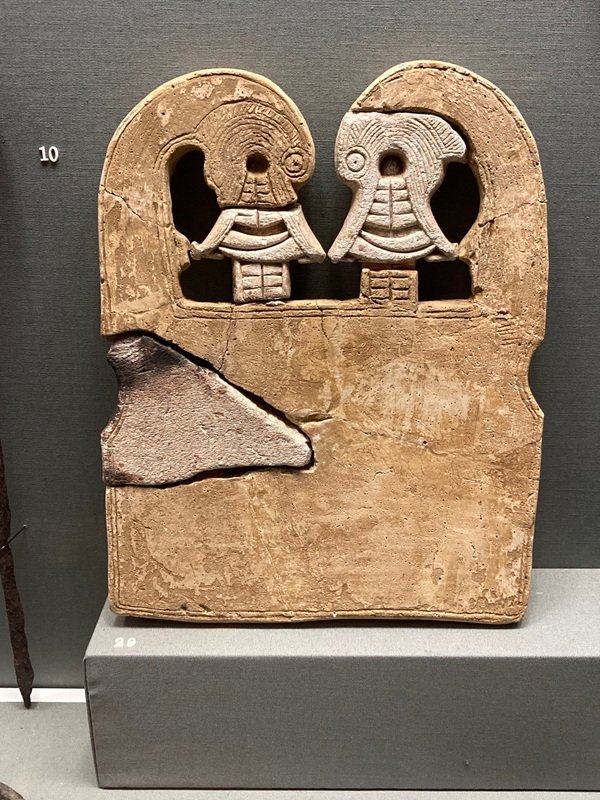
The National Museum of Ireland: This houses some fascinating artefacts with a large section devoted to the Vikings. Most of it concentrated on the later years of their presence (11th century), but also gave lots of general information about them. Dublin was known as one of the main centres for the slave trade, and there were some chains on display at the museum that really brought this home. Other fascinating objects were pieces of Viking graffiti showing longships, as well as the usual assortment of battle axes, swords and jewellery, including various stunning brooches and cloak-pins. There was a beautifully crafted linen smoothing board made of whalebone, (similar to one in Orkney), a pair of bone ice skates, a gaming board and a weaving sword, rare survivors as they were made out of wood. The best, and most useful, display for me was a scale model of what Dublin would have looked like. Small rectangular buildings with rounded corners whose walls were constructed mainly out of hazel, and roofs thatched with reeds. It’s so helpful to be able to study models like that when attempting to describe a place in my stories.
National museum of Ireland
Dublinia Viking Exhibition: This was dubbed as “A Living History of Viking and Medieval Dublin” and featured life-size wax figures. The little scenes from times gone past really brought the era to life vividly. There was a corner where you were allowed to try on Viking clothing and an iron helmet, as well as weapons and shields to hold. It quickly became apparent that the helmet was not made for someone as small as me since (a) it was incredibly heavy and (b) I could barely see out of it! Still, very useful for research purposes.

Dublinia Viking Exhibition
Waterford: Another town founded by the Vikings in the 9th century. They called it Veðrafjorðr (possibly “ram/wether” fjord?) and established another longphort there. The town is situated along the river Suir, not far from the sea, and has always been an important port. I found it picturesque and the surrounding countryside was lovely. On the way back to Dublin, we passed Wexford and decided to pop into the Irish National Heritage Park which is located next to the Slaney river nearby. There were reconstructed buildings to illustrate over 9,000 years of Irish history, and I toured the Viking boatyard, complete with dwelling house and a ship that was more or less finished. They also had a falconry centre with various birds of prey. My absolute favourite was a little peregrine falcon who was quite happy to sit on my hand after I put on a special glove, calm and imperious. Such a beautiful bird!

Irish National Heritage Park